Perfect ice cream isn't a matter of luck. It's a matter of numbers.
And until now those numbers lived in the master's head —or in a mix-stained notebook—. FormulaMaps puts them in front of you in real time: PAC, POD, solids, fat and the freezing curve of every recipe. You type your formula and you know, before you churn, whether it will come out just right. It's the ice cream formulation and balancing program with AI from an ice cream family active since 1947.
👨🍳 An ice cream family since 1947 · ☁️ In your browser, nothing to install · 🌍 5 languages
This is your workshop. You've never seen it like this.
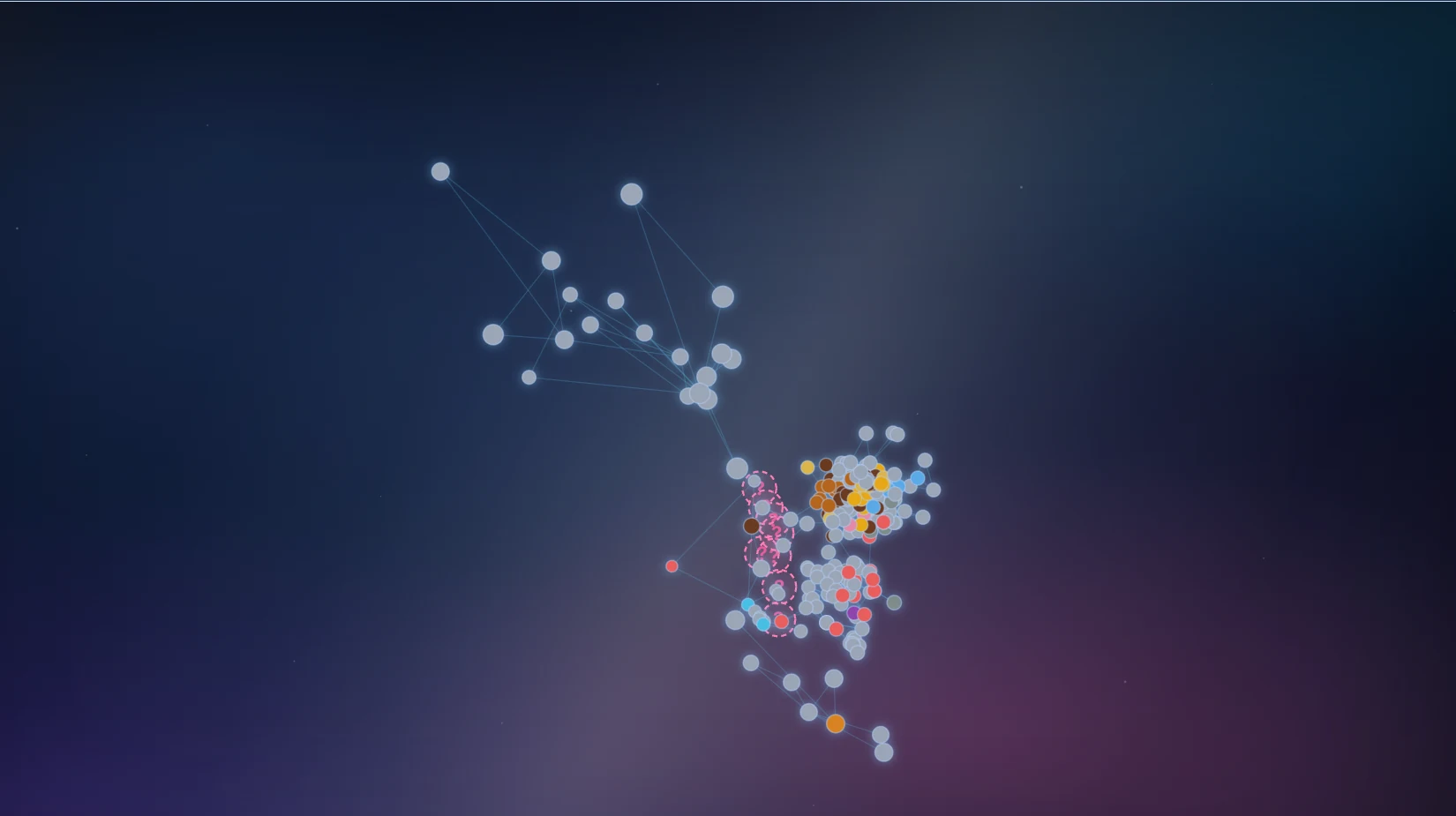
Every star is one of your recipes, placed by its chemistry and linked to its neighbours: 264 formulas from a real workshop on a single map. You stop working blind —you see your families, your winners and, most valuable of all, the gaps: the ice creams you haven't created yet.
Why this supercharges artificial intelligence. Placing each recipe by its chemistry and summarising each type into an average «fingerprint» turns your recipe book into something a machine truly understands. With that structure, an AI model instantly recognises what type a formula is, spots the one that breaks the pattern and predicts or synthesises new, balanced recipes far more easily. It's the same fingerprint that powers our public API and the MCP server.
Every tub you throw away is money melting
When a recipe «won't set» it isn't bad luck: it's a number out of place. And every mistake is paid for twice —in product and in hours—.
The sorbet that comes out like a rock: not enough PAC. Fruit contributes little anti-freeze and you have to make up for it with the sugar blend.
The ice cream that weeps in the display case: too much free water, too few solids.
The one that's cloying: POD through the roof. You bring it down without touching the texture, by changing the type of sugar.
The little crystals after two days: too few milk solids or poor storage of the mix.
The difference between guessing and knowing is a few calculations. FormulaMaps does them instantly, and an AI tutor tells you exactly what to change —and applies it with one click.
The engine's science, in the open
We believe in transparency: this is the physics the calculation runs on. The science is public; the fine calibration (our exact tables and factors) is what tunes FormulaMaps.
1. Freezing-point depression (van 't Hoff)
Adding a solute (sugars, salts) to water lowers its freezing point. The fundamental relationship is:
ΔTf = Kf · m · i
ΔTf: freezing-point depression.
Kf: cryoscopic constant of water = 1.86 °C·kg/mol.
m: molality (moles of solute per kg of free water).
i: van 't Hoff factor (degree of dissociation). For sugars (sucrose, dextrose) i = 1. For milk-serum salts such as NaCl, i ≈ 2, which is why a pinch of salt moves the PAC enormously.
2. Molality is dynamic
The real challenge: molality is not fixed. As the ice cream cools, part of the water turns to ice; less liquid water remains for the same sugars, the solution concentrates and the freezing point drops even further. The engine recalculates molality at every temperature:
m(T) =
Σ (Wj / Mj)Wfree water − Wice(T)
Wj: grams of sugar j (sucrose, dextrose, lactose…).
Mj: molar mass of sugar j.
Wfree water: total water minus the water held by stabilisers and proteins.
Wice(T): water already frozen at temperature T.
3. PAC equivalences (sucrose reference = 100)
Since freezing-point depression is inversely proportional to molar mass, the PAC of any sugar is obtained by comparing it with sucrose:
PACj = 100 ·
MsucroseMj
· ij
Sugar
Molar mass (g/mol)
PAC (sucrose=100)
Sucrose
342.3
100
Lactose
342.3
100
Dextrose (anhydrous glucose)
180.2
≈ 190
Fructose
180.2
≈ 190
Invert sugar
≈ 180
≈ 190
Glucose syrup
depending on DE
variable (lower at lower DE)
Consistency note: we take dextrose as anhydrous glucose (M ≈ 180 → PAC ≈ 190), just like fructose. If dextrose is counted as monohydrate (M ≈ 198), its PAC drops to ≈ 173. It's a modelling choice, not an error: what matters is applying the same criterion to the whole recipe. FormulaMaps is consistent throughout its catalogue.
The mix's total PAC is a weighted sum by the percentage of each ingredient:
PACtotal = Σ ( %ingredientj · PACj )
4. Leighton's method: how much water is frozen
Here lies the engine's true power. A single number isn't enough: you have to know what percentage of the water is frozen at the display-case temperature (for example −11 or −12 °C). An ice cream that's just right needs between 65% and 75% of the water frozen: less, and it's soft or runny; more, and it's hard and grainy.
Freezing curve (Leighton's method): how the ice evolves with temperature. FormulaMaps computes it for every formula and marks your ideal serving temperature. · Illustrative view.
Leighton established that the ratio between the sugars per 100 g of residual water and the freezing-point depression follows a curve; the engine solves it iteratively for the target temperature until it finds the balance between liquid water and ice at that temperature.
The exact shape of that curve (our calibrated cryoscopic tables) is the part that tunes FormulaMaps and that we don't publish in detail — but the Leighton principle is the one you see here, no tricks.
5. Correction for milk solids non-fat (MSNF/SLNG)
Milk proteins and mineral salts (ash) also exert osmotic pressure and lower the freezing point. The engine adds a correction factor to Leighton's method: each gram of MSNF contributes a dissolving power of the order of 0.7 times that of sucrose, due to free lactose and dissociated salts. The exact calibration is part of the FormulaMaps catalogue.
The fingerprint of every ice cream
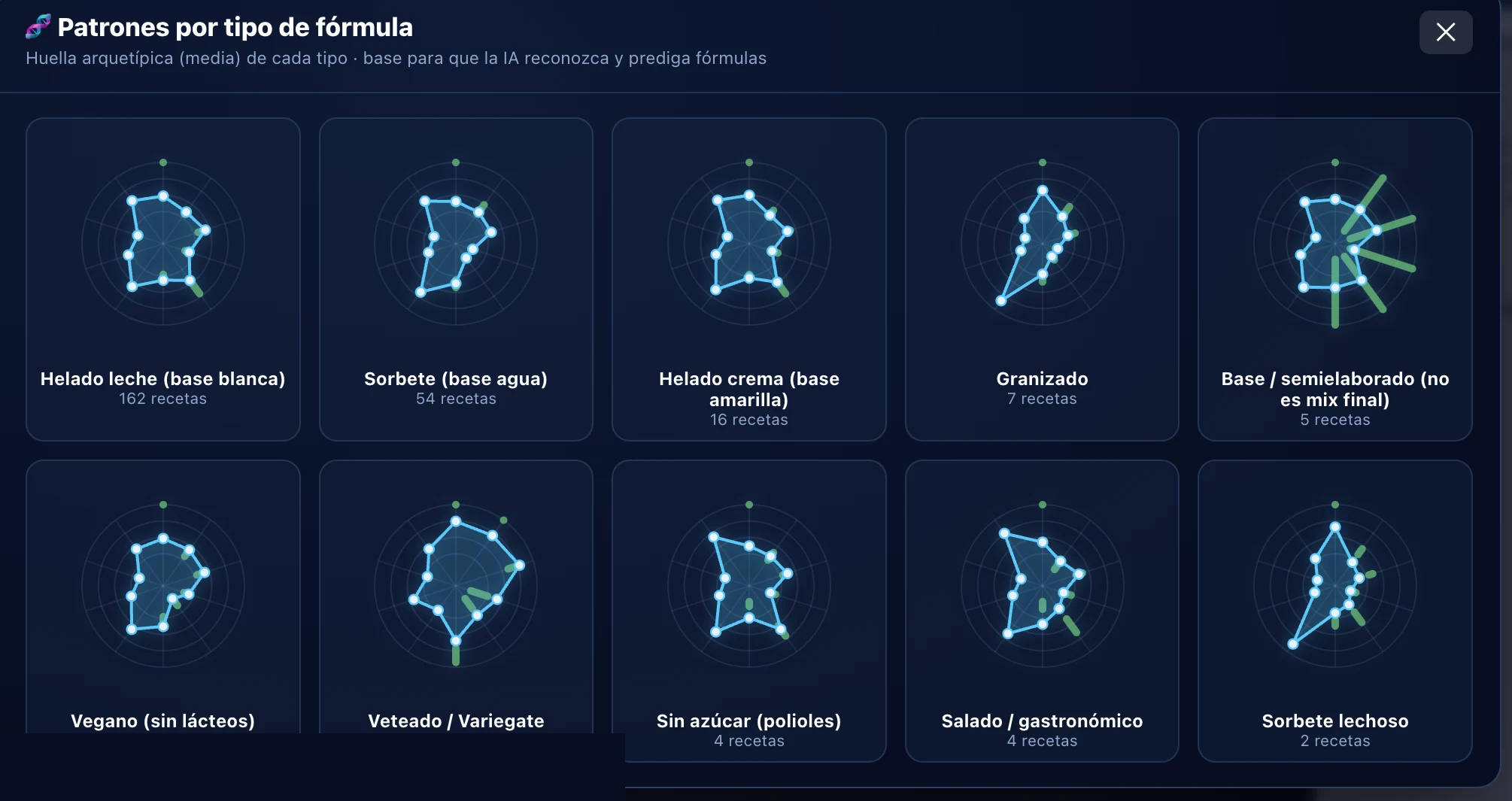
FormulaMaps summarises each formula type in its average «fingerprint»: a family portrait. It's not just pretty —it's the language the AI uses to recognise, compare and predict new recipes.
Milk ice cream, water sorbet, cream, granita, vegan, sugar-free, salted… each type with its signature. The more recipes, the sharper the fingerprint —and the easier it is for a model to predict the next balanced formula.
How the artisan sees it
All that maths is served to you as one number you actually use, not as an abstract index.
PAC as serving temperature (°C). FormulaMaps shows you the PAC on your working scale: a negative value close to the ice cream's ideal serving temperature (for example, −11.5 °C), within a healthy range of −12.5 to −10.6 °C. It's the number the ice cream maker looks at to know whether the ice cream will be just right in the display case.
The classic index (PAC with sucrose = 100, from which all the science above derives) is offered as a secondary reference for those who need it or for external tools — but the main number, the one you use every day, is the serving temperature.
Alongside the PAC, the engine calculates POD (sweetness), total solids, fat, MSNF, free water and the full freezing curve, with the correct range for the type (cream, water sorbet, milk sorbet, sugar-free, vegan…).
Ice cream hardness, made to order
Hardness is no longer discovered at the display case: it's decided in the formula. Two ice creams with the same total sugar can come out one creamy and one like a brick — what changes isn't the amount, it's the blend.
Every sugar moves two levers at once —sweetness (POD) and hardness (PAC)— and almost never equally: dextrose softens a lot while sweetening little, atomized glucose adds body while barely moving either, and fructose and invert sugar are powerful on both.
Serving temperature is the result: the engine translates your sugar blend into the real °C of your display case (healthy range −12.5 to −10.6 °C) and the full freezing curve.
Stabilizers play too: they bind free water and steady texture and melt-down. Stabilizer composition →
The PAC field is the serving temperature (negative); PAC_indice_clasico is the sucrose=100 index described above.
Your next tub, built right. Start free.
Three formulas free, forever and with no card. In five minutes you have your first balanced ice cream, with the science of a 1947 workshop and the help of AI.