That number is the almond percentage and its balance with the honey. From it come the PGI category, the cooking point and the shelf life of your turrón (Spanish nougat). FormulaMaps calculates it for you —on the finished product, as the official standard requires— and tells you whether your formula is Suprema, Extra or falls short: Jijona, Alicante, toasted-yolk, Toledo marzipan or guirlache. It is AI-powered turrón formulation, from a workshop family since 1947.
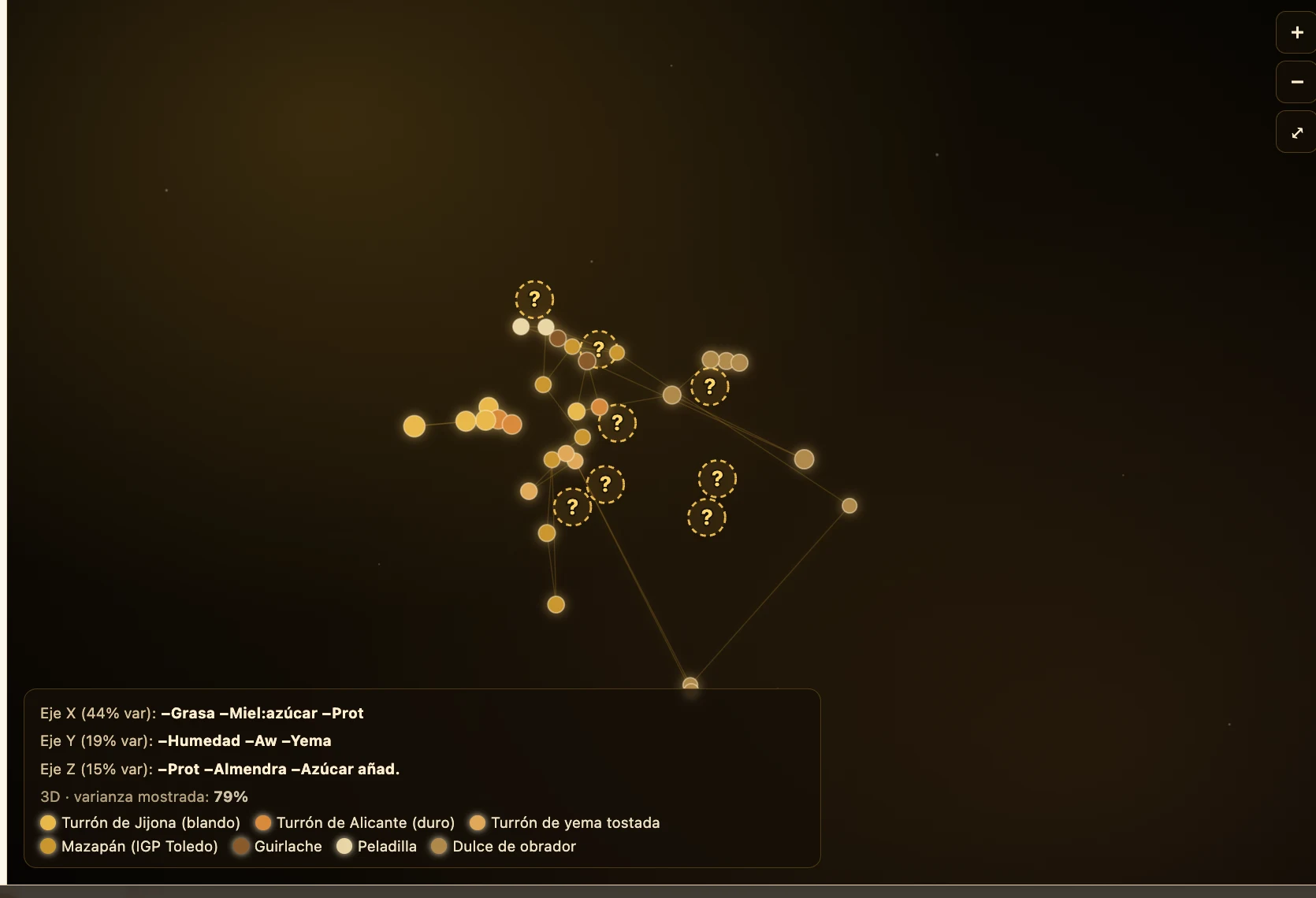
Each star is a formula, placed by its composition —almond, honey, sugar, fat, moisture— and joined to its neighbours. At a glance you see your families —Jijona, Alicante, yolk, marzipan—, your Supremas and the gaps: the turrones you have not yet created.
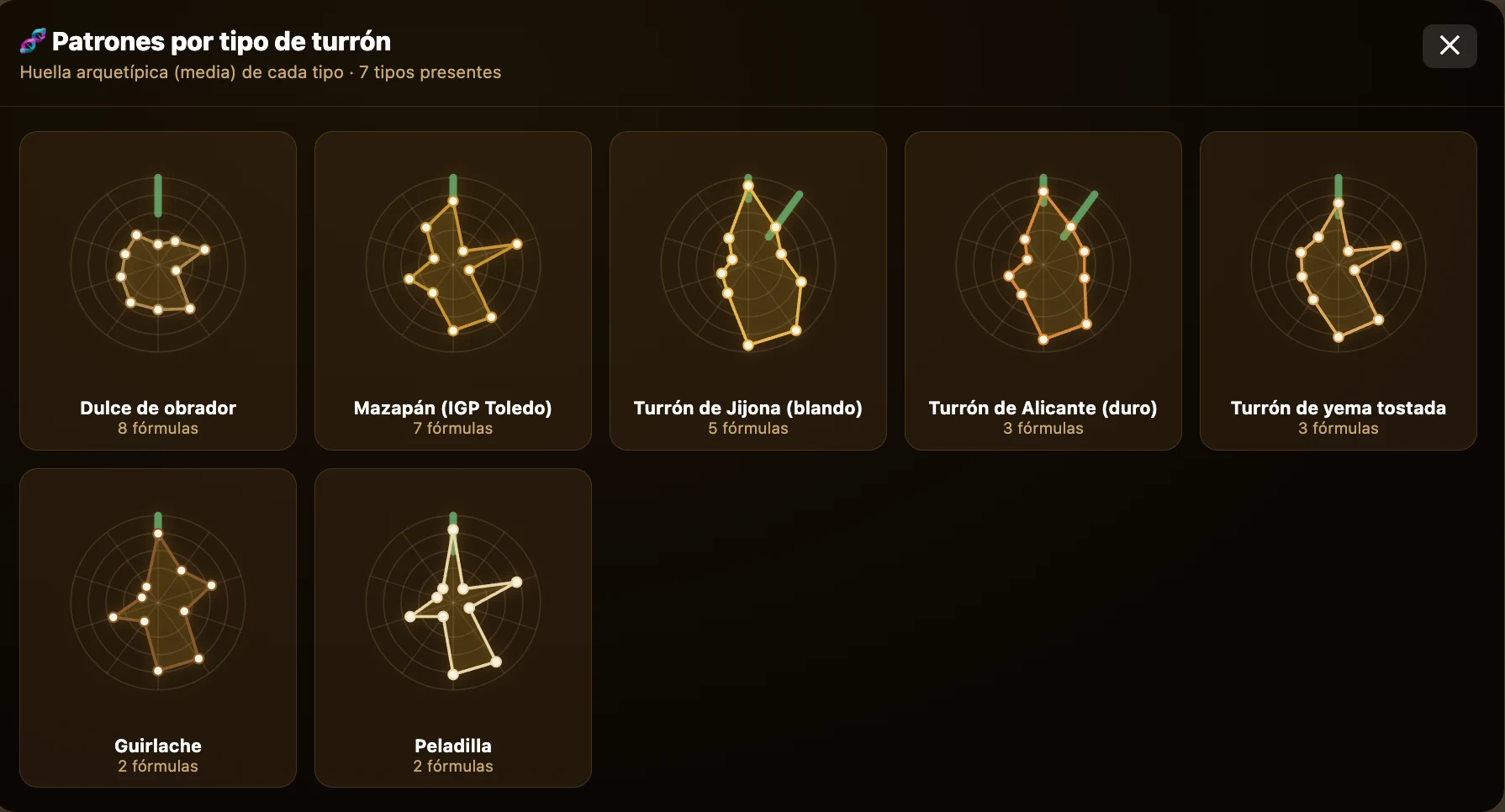
FormulaMaps summarises each type —Jijona, Alicante, toasted yolk, marzipan, guirlache, peladilla— in its average «fingerprint»: a family portrait. It is the language with which AI recognises the type and predicts new formulas.
It fails because of a number out of place. And with turrón you pay for it with a bar that turns sandy, goes rancid or never reaches its category.
Each one is a number. FormulaMaps shows it to you —and an AI tutor tells you how to adjust it.
This is the maths the turrón engine processes. The science is public; the fine calibration (the per-type thresholds and the shelf-life ranges) is what FormulaMaps tunes. Based on the PGI standards for Jijona and Turrón de Alicante (MAPA), RD 1787/1982 and the PGI for Toledo Marzipan.
The PGI % is measured on the finished turrón. That is why the engine deducts the free water added (it evaporates when cooking the syrup) and the wafer (it does not count towards the mass percentage). Almost nobody gets this right:
The two numbers that define turrón, always on the basis:
A true Jijona is sweetened above all with honey, not sugar. The engine calculates the ratio between the honey and the added sugars (sugar + glucose): when honey leads, quality rises.
Each type has its threshold. If your % of almond (and of honey, where it applies) falls within it, you get a category; if not, the engine tells you how much you are short. The score is 1, 2 or 3 almonds (bronze · silver · gold).
| Type | Suprema (almond) | Extra (almond) | Min. honey |
|---|---|---|---|
| Jijona turrón (soft) | ≥ 64 % | ≥ 50 % | ≥ 10 % |
| Alicante turrón (hard) | ≥ 60 % | ≥ 46 % | ≥ 10 % |
| Toledo Marzipan (PGI) | ≥ 50 % | ≥ 45 % | almond:sugar ≈ 1:1 |
Sugar changes texture with temperature: the hotter it gets, the more water evaporates and the higher the concentration, and that is why each stage —from the thread to the caramel— gives a different hardness. Each type of turrón cooks to its own point: Jijona should not go beyond soft ball (a gentle second cook in the boixet), while Alicante reaches hard crack/caramel (≈150 °C) and is poured at 139–145 °C over the whipped egg white.
Syrup cooking curve: the higher the temperature, the higher the sugar concentration and the harder the result. The points mark where each turrón cooks.
The Aw —the «free» water available to microbes and reactions— governs preservation. It falls as sugar rises (which binds the water) and rises with the product's moisture. The engine estimates it, and from there derives the shelf life and the risk of sanding (crystallisation):
The engine tracks the cost per kilo of your formula and, with your retail price, gives you the margin instantly. The same workshop quality, from the almond % to the sale price.
FormulaMaps guides you on the category your formula would meet, but certification is granted by the Regulatory Councils. Here are the official standards so you can consult them first-hand.
The turrón engine is machine-consumable: an agent can analyse a formula with the same calculation and cite the source.
POST /api/balance/turron — % of almond and honey, honey:sugar ratio, PGI category and medal.turron_balance · manifest at /.well-known/mcp.jsonThree free formulas, forever and no card. In five minutes you know whether your Jijona is Suprema and to what point to cook the syrup.
The values, PGI thresholds and shelf-life ranges are indicative and support the professional's decision. FormulaMaps does not certify and does not replace laboratory analysis or the certification of the Regulatory Council.