Every calculation, in the open
This is the maths the baking engine runs. The science is public; the fine calibration (our ranges by style) is what makes FormulaMaps sharp.
1. Baker's percentage (flour = 100)
Everything is expressed as a percentage of the flour, which is always 100. That's how you compare and scale any dough without recalculating:
ingredient% =
grams of the ingredientflour × 100
2. Real hydration (not just the water you pour in)
The key almost nobody counts properly: water doesn't come from the tap alone. Milk, egg, butter and honey hydrate too. The engine adds up the real water in every ingredient:
| Ingredient | Water it contributes |
|---|
| Water | 100% |
| Milk | 87% |
| Egg | 75% |
| Honey | 17% |
| Butter | 16% |
hydration =
real water of all ingredientsflour × 100
Sourdough is assumed at 100% hydration (half flour, half water): that half is added to the effective flour and shown separately as a preferment, so the hydration figure never fools you.
3. Salt, yeast, fat and sugar
All in baker's percentage. Salt sits around 2–3% (less, and the dough ferments out of control; more, and it holds the yeast back). Yeast is expressed as fresh —if you use instant dry, multiply by 3 to compare—.
4. Total hydration (TA)
The Italian/French index that sums up the dough in a single number: flour (100) plus its hydration.
TA = 100 + hydration
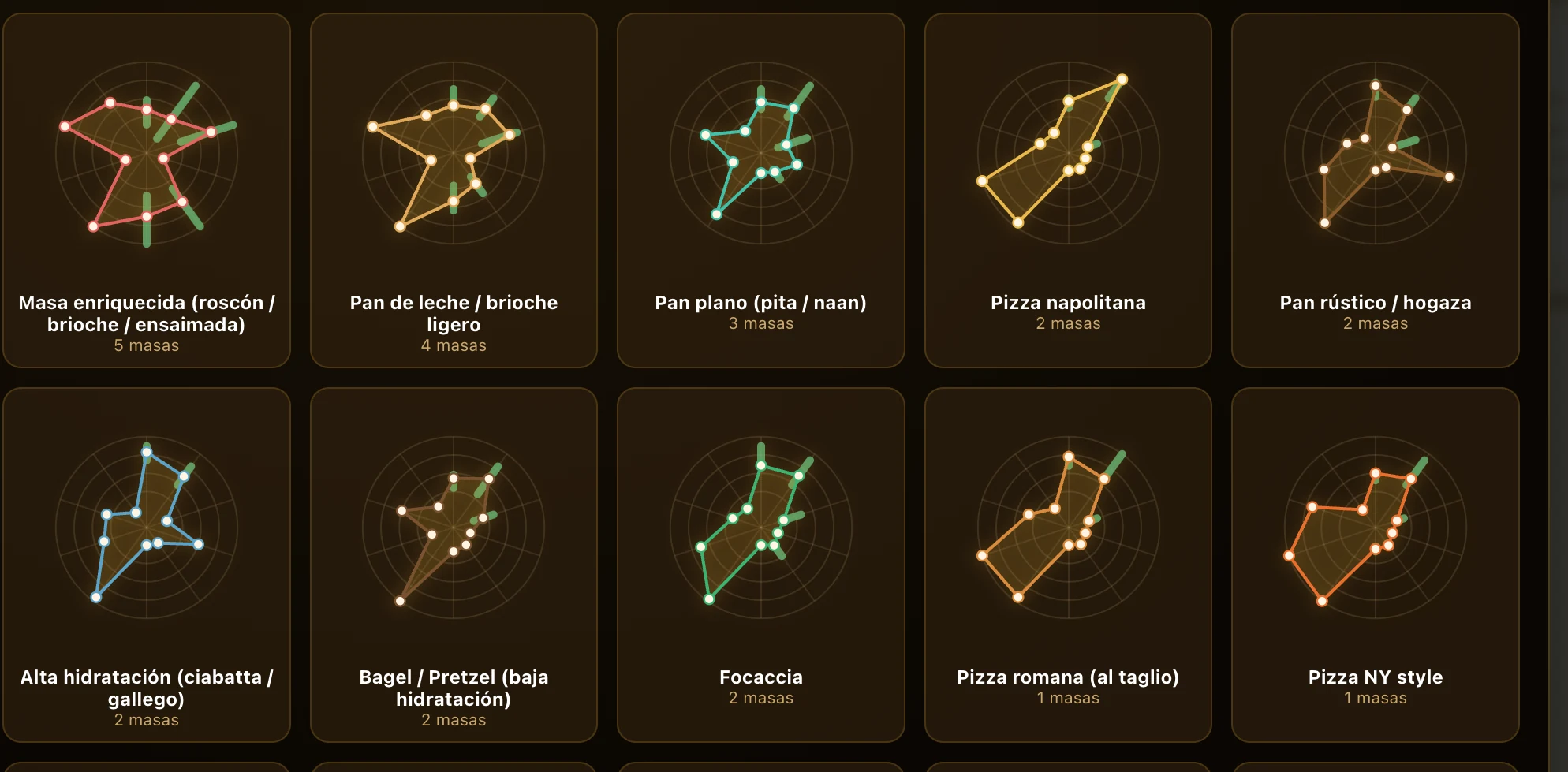
5. The ranges by style → the medal
Every dough has its window. If your parameters land inside, you get a medal; if not, the engine tells you which one and which way to move.
| Style | Hydration | Salt | Yeast (fresh) |
|---|
| Neapolitan pizza (AVPN) | 58–65% | 2.2–3.0% | 0.05–1% |
| Pizza in teglia / al taglio | 70–85% | 2.0–2.6% | 0.3–1.5% |
| Rustic sourdough bread | 68–82% | 1.8–2.3% | 0–0.5% |
These ranges are a sample. The full catalogue (everyday bread, baguette, ciabatta, sandwich loaf, brioche, rustics, laminated doughs…) is the part that makes FormulaMaps sharp.
6. Flour strength (W)
The W tells you how much fermentation a flour can withstand before it collapses. The higher the W, the more tenacious the dough and the longer the ferments it takes (Neapolitan pizza, panettone); the lower the W, the more suited it is to short-ferment breads. FormulaMaps guides you on the right strength for the style and the fermentation time you're after.