That curve is tempering, and together with the % cocoa and the cocoa butter it defines the shine, the snap and the keeping of your chocolate. FormulaMaps calculates it for you —% cocoa, fat, fineness, the tempering curve and, for the ganache, the shelf life in days from its water activity— and tells you whether it qualifies as dark, milk or white chocolate, or couverture. This is AI chocolate formulation, from a workshop family since 1947.
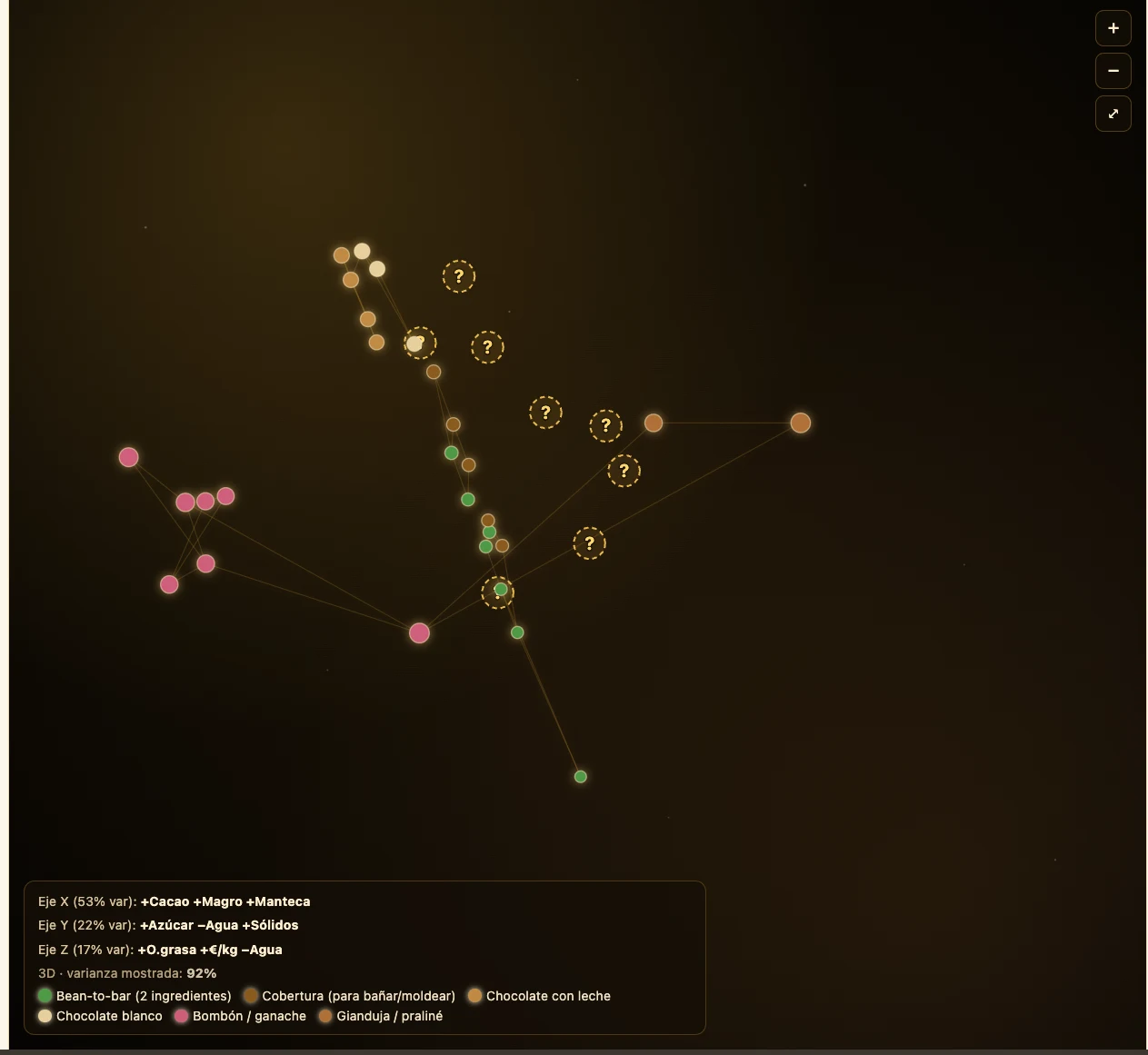
Every star is a formula, placed by its composition —cocoa, cocoa butter, sugar, dairy, fat— and joined to its neighbours. At a glance you see your families —dark, milk, white, couverture, gianduja, praline—, your balanced ones and the gaps: the chocolates you haven't created yet.
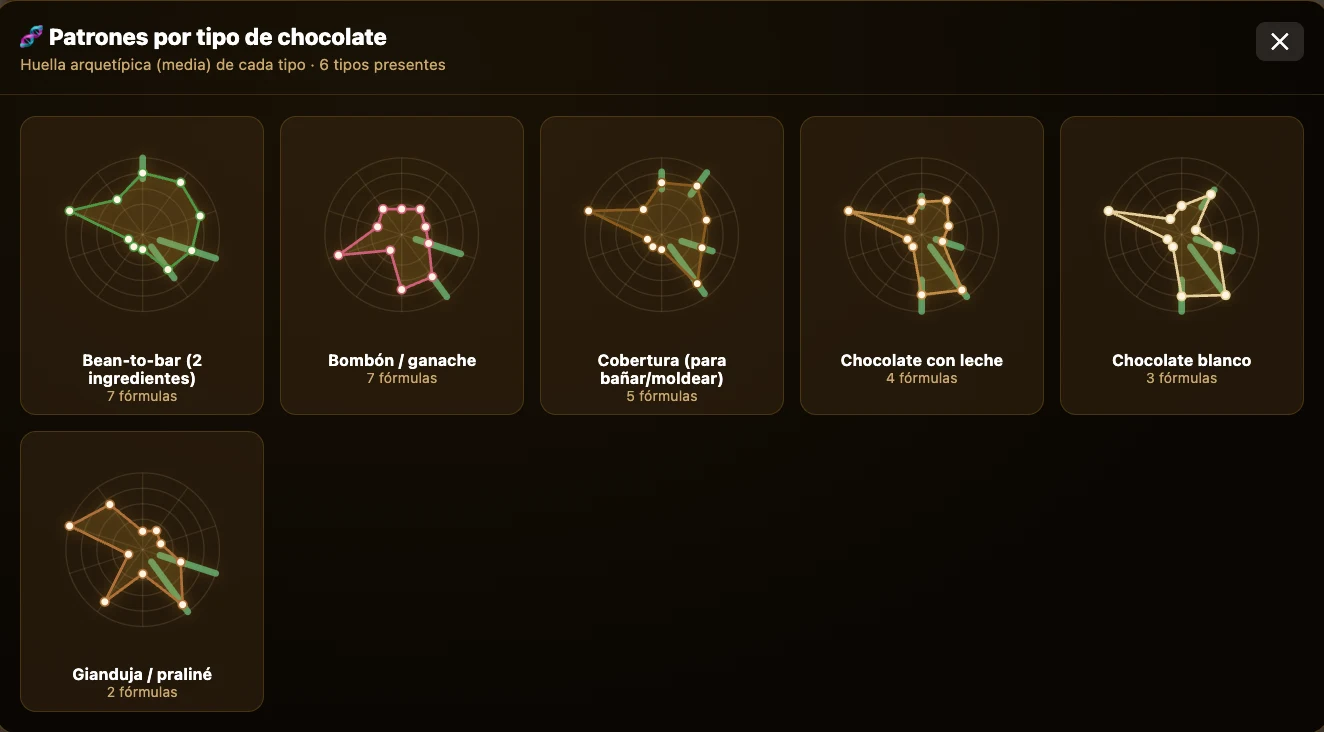
FormulaMaps summarises each type —dark, milk, white, couverture, gianduja, praline— in its average «fingerprint»: a family portrait. It's the language AI uses to recognise the type and predict new formulas.
It fails because of a number or a temperature out of place. And with chocolate you pay for it in lost shine, blooming and fillings that don't last.
Each one is a number. FormulaMaps shows it to you —and an AI tutor tells you how to adjust it.
This is the maths the cocoa engine runs. The science is public; the fine calibration (the good-practice ranges by type) is what FormulaMaps tunes. Legal minimums per Directive 2000/36/EC and Spanish RD 1055/2003.
The % cocoa is the sum of the cocoa butter and the fat-free cocoa solids (lean cocoa) over the finished product. Cocoa mass provides both; adding cocoa butter raises the % and the fluidity.
The fat that flows isn't only the cocoa's: milk fat and hazelnut fat count too. The engine adds up the total fat, which governs the fluidity and the tempering.
The target fineness is around 20-25 µm: below that, the chocolate feels silky; above it, gritty.
Each name demands certain minimums. The engine tells you whether your formula would qualify as dark, milk or white chocolate, or couverture.
| Name | Cocoa | Cocoa butter | Other |
|---|---|---|---|
| Chocolate (dark) | ≥ 35 % | ≥ 18 % | lean ≥ 14 % |
| Milk chocolate | ≥ 25 % | — | dairy ≥ 14 % |
| White chocolate | — | ≥ 20 % | dairy ≥ 14 % |
| Couverture | ≥ 35 % | ≥ 31 % | for coating/moulding |
Tempering means guiding the cocoa butter to its stable crystal (β / form V): melt, cool by seeding crystal and raise to working temperature. That way the chocolate comes out glossy, snaps and doesn't bloom. Each type works at its own point:
Tempering curve: melt (≈45-50 °C) → seed (≈27-29 °C) → work. Working points: dark 31-32 °C, milk 29-30 °C, white 28-29 °C.
The «free» water in a filling (aw) rules its keeping. FormulaMaps estimates it from the cream and the humectants (invert sugar, glucose, sorbitol) and gives you an indicative shelf life in days at 18 °C:
| Water activity (aw) | Approx. shelf life (18 °C) |
|---|---|
| ≤ 0.80 | ≈ 30–45 days |
| 0.80 – 0.85 | ≈ 21–28 days |
| 0.85 – 0.88 | ≈ 12–18 days |
| 0.88 – 0.90 | ≈ 8–12 days |
| > 0.90 | < 7 days (refrigerate) |
The engine tracks your formula's cost per kilo and, with your retail price, gives you the margin instantly. From % cocoa to selling price.
FormulaMaps guides you on the name your formula would qualify for. Here is the official regulation to consult first-hand.
The cocoa engine is machine-consumable: an agent can analyse a chocolate or a ganache with the same calculation and cite the source.
POST /api/balance/cacao — % cocoa and cocoa butter, fat, legal classification, tempering and ganache aw.cacao_balance · manifest at /.well-known/mcp.jsonThree free formulas, forever and no card. In five minutes you balance a bean-to-bar, a couverture or a ganache with its shelf life.
The values, legal minimums and keeping ranges are indicative and support the professional's decision. FormulaMaps does not certify or replace laboratory analyses.